
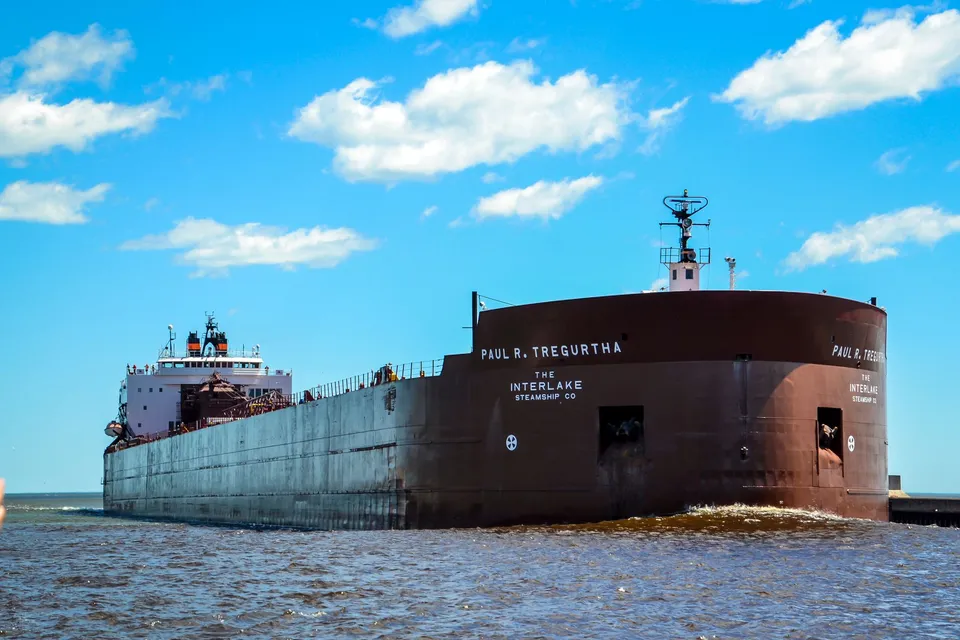
A Duluth job offer feels different when you picture the ride home, not just the job itself. Here, the workday can touch a DTA route in Duluth or Superior, a freight corridor tied to rail and highways, and a trail system that gives you a place to decompress without driving to another town. That matters because the local systems that shape daily life are real and specific: DTA lets riders choose route, day, and direction and also posts service alerts and an emergency weather schedule; the Duluth Seaway Port Authority describes a harbor built around bulk docks, a general cargo terminal, a shipyard, tug/barge services, and links among water, rail, and highways; and Lake Superior College offers continuing education, customized training, and on-demand learning that can fit around a shifting schedule. (duluthtransit.com)
The commute is a map, not a mileage number
DTA publishes both Duluth and Superior routes, including service such as 110 to Superior-Tower Avenue and 111 Superior Circulator, so a job near the state line does not automatically share the same transit reality as one in central Duluth. Because the system also separates weekday, Saturday, Sunday, and holiday schedules, the fit of a job can change when a shift starts early, runs late, or lands on a weekend. For applicants and employers alike, that means the safest question is not simply whether there is a bus, but which route, which day, and which direction will actually serve the shift. (duluthtransit.com)
That matters in the Duluth area because the practical commute is rarely just a straight line on a map. A role in Duluth can feel very different from one in Superior, and a household in Hermantown, Proctor, or Rice Lake may judge the same offer by a totally different drive, transfer, or backup plan. The route itself becomes part of the job fit, not just a detail after the offer letter arrives. (duluthtransit.com)
The port explains why work here can feel layered
The port side of the Twin Ports economy is equally multi-layered. The Port Authority says the Clure Public Marine Terminal is the harbor’s only breakbulk and general cargo maritime freight facility and notes on-dock rail with direct access to four Class I rail carriers plus highway access. The port also says it generates more than $1 billion in business activity each year. That does not tell a newcomer which single job to take, but it does explain why the same area can support freight, warehousing, maintenance, shipping, and logistics work that moves by water, rail, or truck rather than by one clean lane. (duluthport.com)
If you are evaluating a role near the harbor, that detail matters because the operating rhythm may be shaped by cargo transfers, rail handoffs, or vessel activity as much as by a standard office calendar. That is an inference from the port’s own description of its facilities and connections, but it is a useful one for someone deciding whether a schedule, a commute, and a work environment fit together. (duluthport.com)
Training that can move with the shift
Lake Superior College adds another kind of mobility: skill mobility. Its Continuing Education and Customized Training division says it offers flexible on-demand training for individuals and businesses, and that it can customize training for employer needs. The college’s program pages also show online and on-campus delivery options, and the on-demand catalog includes examples such as CPR, CDL theory, passenger endorsement, and school bus endorsement. For a person moving for work, that matters because a good local move is not only about landing the first job; it is also about finding the next credential without rebuilding life around a rigid class schedule. (lsc.edu)
That flexibility can matter to employers, too. A posting that assumes every worker has the same hours, the same commute, and the same free time can be harder to fill than one that respects the actual training and travel patterns of the region. In a market where jobs, class schedules, and routes all interact, even a small amount of schedule awareness can make a role more realistic for the people you want to reach. (lsc.edu)
Trails are part of the daily equation, not an extra
The trail system is the piece that makes the rest of the day feel livable. Duluth’s paved and gravel trail directory includes the Lakewalk, the Cross-City Trail, and Waabizheshikana: The Marten Trail, and the city also points users to an online parks and trails map. Those trails are not interchangeable, so the responsible move is to check the map rather than assume every path works the same way. For a newcomer, that is more than recreation trivia. It means the place where you walk after a shift, bike before a shift, or clear your head on a day off can be part of the housing and job decision, not an afterthought. (duluthmn.gov)
That is especially useful for people weighing Duluth, Superior, Hermantown, Proctor, or Rice Lake. The right trail for a quiet reset may be near one neighborhood and not another, and the point is not to chase a perfect postcard setting. It is to know where you can reliably go on an ordinary Tuesday when work has already taken enough out of you. (duluthmn.gov)
What this means for applicants and employers
For applicants, the practical test is simple: imagine Tuesday at 6:30 a.m., Saturday at 2:15 p.m., and a week when service alerts or weather change the plan. DTA’s separate weekday, weekend, holiday, and emergency-weather schedules mean the normal commute is not always the real one, especially if the job touches Duluth, Superior, or a shift-work environment. A strong offer is one that still works when the easy day is gone. (duluthtransit.com)
For employers, the lesson is equally practical. A role that lines up with a realistic route, a local training path, and a usable place to reset after work has a better chance of feeling sustainable to the person you want to hire. That is not a guarantee of faster hiring or better retention, but in a region shaped by transit, port logistics, and trail access, it is a smarter starting assumption than treating every job as if the surrounding city were interchangeable. (duluthtransit.com)
A simple next step
Before you decide whether a Duluth-area offer fits, compare one route, one trail, and one training option side by side. If those three pieces make sense together, the job is more likely to fit real life, not just a résumé. (duluthtransit.com)